Begin a Lincoln Resident Search
Let the question pick the record. An owner question points to Placer Assessment Inquiry and the Recorder. A current registration question points to California's authenticated voter service. A past-household question needs deeds, census schedules, directories, newspapers, or probate. A business connection belongs in state entity files, fictitious business-name records, or city licensing. Location matters too. An address may sit inside incorporated Lincoln or merely carry a Lincoln mailing address in western Placer County.
Each source describes a different relationship. An assessment roll can show an owner, a situs address, values, exemptions, and a transfer reference. A deed index names parties to an instrument. A permit identifies an applicant, contractor, project, or work date. No single field proves who sleeps at the property. Names need the same care. A case number, date, parcel, spouse, business, or document reference helps separate two people who share one name.
The first pass can follow five linked steps. Each step leaves an evidence trail that makes the next one more precise.
- Write down the exact name, address, unit, directional, approximate date, and reason for the search.
- Use the county GIS map for an address and record the parcel or assessment key it returns.
- Run the parcel key through Assessment Inquiry, then use the owner name in the Recorder index.
- Use My Voter Status only for an authenticated personal check, or apply through the qualified voter-data route.
- For older clues, compare the 1861 directory catalog, archival indexes, census schedules, newspapers, and a targeted records request.
Lincoln's Placer County Records Desk
Lincoln keeps no municipal recorder, assessor, vital-record registry, or trial court of its own. Placer County serves as the main records desk for deeds, assessments, elections, marriages, local births and deaths, and Superior Court cases. The City Clerk still matters for Lincoln-created records. That includes council files, permits, and licenses. It also covers existing records requested under the California Public Records Act. The office split is practical. The right custodian can find a record that the wrong office cannot. A residents directory search in Lincoln should begin at the county level. It should finish at City Hall.
Placer County Clerk-Recorder
3715 Atherton Road
Rocklin, CA
530-886-5600 recording
The Recorder's online index is free for party, document, and date research. Treat it as a reference layer rather than a remote deed-image library. Assessment Inquiry is parcel-keyed. Elections data carries purpose and confidentiality limits. The Placer Superior Court is the custodian for probate, family, civil, and small-claims cases. It also handles traffic matters. Marriage certificates belong with the Clerk-Recorder. Divorce files belong with Superior Court.
From Lincoln Address to Parcel
A street address is a common starting clue. The county's parcel map is the cleanest bridge. The Placer Parcel, Zoning and Land Use Map accepts an address or parcel identifier. Search, zoom, and select the polygon. Record the APN context, subdivision, zoning, and situs information. The free Assessment Inquiry asks for a 12-digit Fee Parcel Number. A 12-digit Assessment Number also works. It offers no simple owner-name or street-address search.
A parcel result can connect a location to assessed ownership information. Map references, values, exemptions, a last-transfer date, and a deed number come with it. The site address and the owner's mailing address are separate fields. A mailing address outside Lincoln may reflect a remote owner. It may also reflect an old record or a tax correspondence destination. A Homeowners' Exemption can support an owner-occupancy clue. It does not prove that every titled person lives there.
| Fee Parcel Number | 12-digit key for the parcel and related bill records |
|---|---|
| Assessment Number | 12-digit key for a particular assessment |
| Aircraft Tail Number | Key for an unsecured aircraft assessment |
| Agreement checkbox | Accepts the Assessment Inquiry disclaimer before the search |
GIS and the assessment roll answer different questions. GIS supplies the parcel shape and planning context. Assessment Inquiry supplies roll facts through the parcel key. For a lawful selected-area extract, the Assessor's PCA503 request allows APN, map-book, tax-code, group-code, or spreadsheet selection. It can deliver CSV or GIS formats after payment. Build any whole-street search from documented APNs rather than a guessed ZIP.
What the Lincoln Property Roll Shows
Property records earn their keep by tying names to durable parcel evidence. The documented assessment fields include APN, map book, tax-rate area, use codes, acreage, exemptions, certified values, last transfer date, deed number, owner name, owner mailing address, and site or situs address. The roll is an ownership and tax record. It is not a citywide residents directory and it does not list every household member.
Placer's free GIS extract deliberately omits owner names while retaining parcel, land-use, value, owner-address, shape, and situs fields. The county routes owner-information requests to the Assessor. That distinction matters when a reader sees a map and expects a name. It also keeps an address lookup honest. A polygon may show where land sits without disclosing the current household.
- Parcel
- A mapped property unit identified by an APN or assessment number.
- Situs address
- The physical location of the assessed property.
- Mailing address
- The destination for owner or assessment correspondence.
- Legal description
- The title language that can persist when a street address or APN changes.
- Criss-cross directory
- An address-ordered directory that may connect a place to a published occupant for a particular year.
Lincoln Deeds Behind a Name
The Recorder keeps a daily grantor/grantee index. It tracks property parties, not streets. Start with the owner name from the parcel step. Search both roles, grantor and grantee, and narrow the results by document type or recording date. A hit can yield a document number and recording reference. Scanned originals live at the Recorder counter for public research or copying, not as remote images on the public index.
Once you can identify a document, request a copy by document type, named parties, reference, or older book-and-page details. The published fee list is straightforward. Noncertified copies cost $2 for the first page and $1 for each added page. Certification adds $2, and fax or email delivery runs $4.25. Mail requests need a return address, daytime phone, payment, and enough identifying detail for staff to locate the instrument.
Title evidence lives in the deed. The assessment roll is only a current clue. The Recorder holds the conveyance itself. The two systems may briefly disagree, since Recorder fraud notices can arrive before an Assessor ownership update on the parcel.
Note: Ask the Recorder at 530-886-5600 for the earliest searchable online date because the published page does not state the index's beginning year.
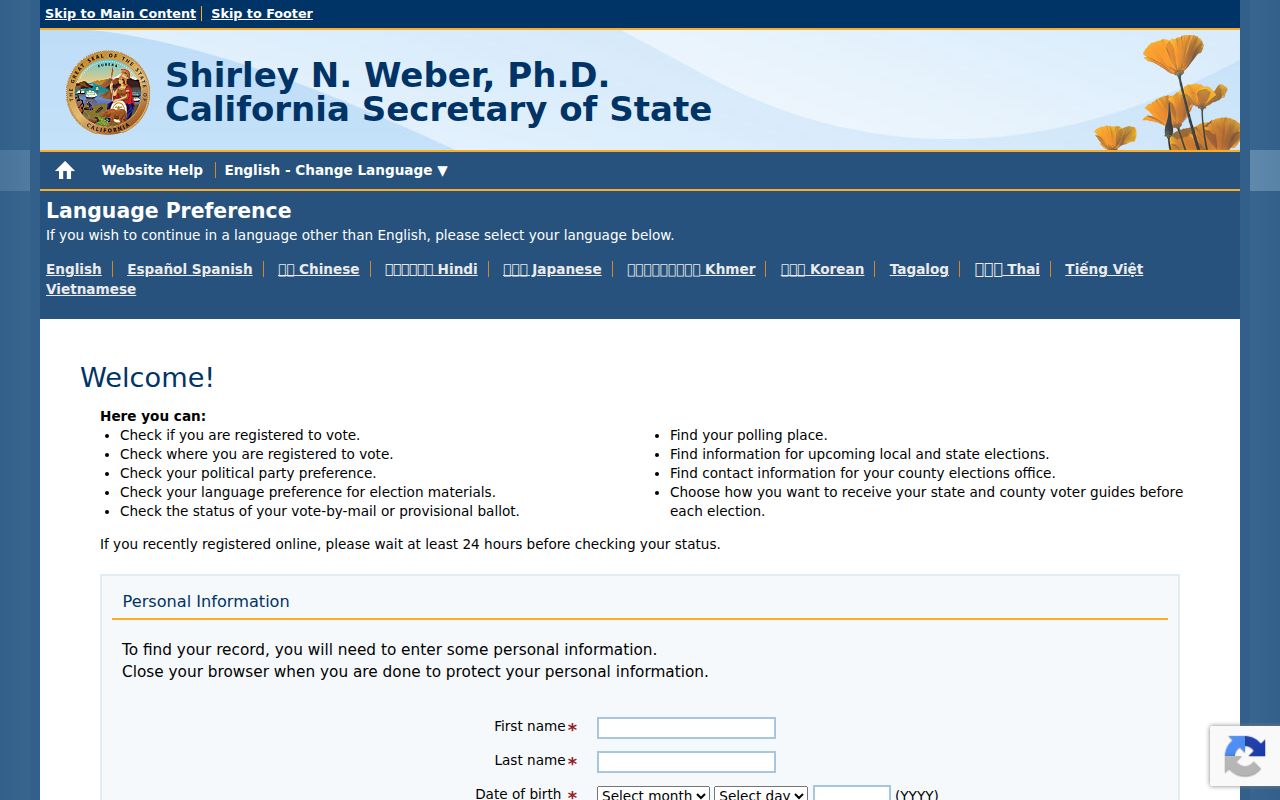
My Voter Status Is Not a Street Roll
California's My Voter Status is an authenticated personal lookup. It asks for a first name, last name, and birth date. When prompted, it wants a California driver license or ID number, or the last four digits of a Social Security number. A result can show your own status, party preference, precinct, districts, voting location, vote-by-mail details, and ballot status. It never shows ballot choices.
You cannot browse it house by house. Qualified-purpose voter-file requests sit under Elections Code sections 2188 and 2194, plus related regulations and confidentiality rules. A state request may need a full name, date of birth, county, and residence address. The fee schedule splits statewide files from specific records. Commercial use is barred. Safe at Home voters register confidentially.
Treat the voter route as one authorized confirmation, not the missing master residents directory for Lincoln. A missing name proves nothing. The record may be protected. The question may not be the voter's own, or the answer may require a permitted file request through Placer Elections.
California's My Voter Status service shows the authenticated lookup route.
Current Lincoln Directory Sources
Read current directory-style sources as separate evidence layers. They overlap in spots. Each row answers a different question about who lives in Lincoln, and none should be stretched into a complete roster of every resident.
| Source | What It Identifies | Keeper | Access |
|---|---|---|---|
| Assessment roll | Owner, situs, mailing, values, exemptions | Placer Assessor | 12-digit parcel key |
| Recorder index | Deed parties and recording references | Placer Clerk-Recorder | Free index; images at counter |
| Voter status | One voter's own registration status | California Secretary of State | Authenticated lookup |
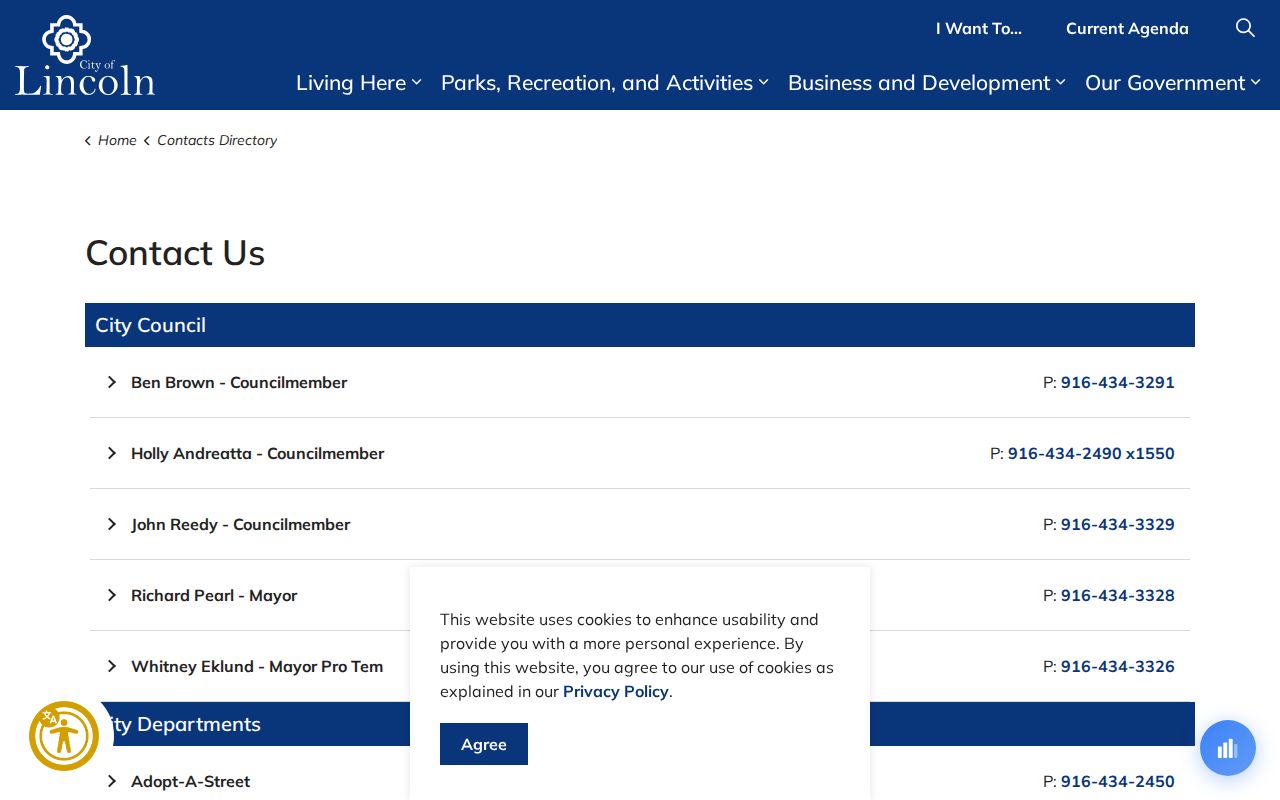
| City contacts | Public officials and department contacts | City of Lincoln | Free web directory |
| Permits and licenses | Projects, applicants, businesses, and locations | Lincoln or Placer | Portal or records request |
The City of Lincoln takes public-records requests online, by email, in person, or by phone. Include a date range and the record class. Add the exact address or APN if you know it. The City Clerk's published contact is 600 6th Street, Lincoln, California 95648, 916-434-2490 extension 4, with city hall hours Monday through Friday, 8:00 a.m. to 5:00 p.m. City records can supply an address-dated permit or council reference. But a city applicant is not automatically an occupant of the property.
Lincoln Business and License Clues
A Lincoln resident search sometimes starts with an organization. California's Secretary of State bizfile links a business name or number to entity status and formation or registration details. It also shows principal and mailing addresses, an agent for service, and filed statements or images when available. Those are filing addresses and affiliations. They are not residence proof. Placer fictitious business-name statements add a local trade-name trail, while Lincoln's city license process covers businesses inside city limits.
The Department of Consumer Affairs license search adds another official name check. Board and license records vary by profession. They may show a license number, status, or dates. A professional address can be a practice. Match it with a parcel, date, entity filing, or other independent anchor before treating two records as one person.
Lincoln routes license applications, renewals, and research through an electronic portal; county-only businesses outside incorporated Lincoln use Placer's county process instead. A city licensing update was recorded in 2026. Check it against the current fee schedule before paying.
When Lincoln's Portal Ends
When Lincoln's portal ends, state law steps in. Government Code Division 10, sections 7920.000 and following, lets any person request an existing city or county record. Agencies generally answer within ten calendar days. A written fourteen-day extension is allowed for unusual circumstances. Inspection is ordinarily free, though direct duplication or other lawful costs may apply to copies and special electronic work.
Write a narrow request. Name the custodian, describe the record class, and give the address or APN. State a date range. Ask for records that already exist. CPRA never forces an agency to create a report, disclose confidential vital indexes, or release exempt personal information. The City Clerk can route police-report questions, but law-enforcement exemptions and redactions may apply.
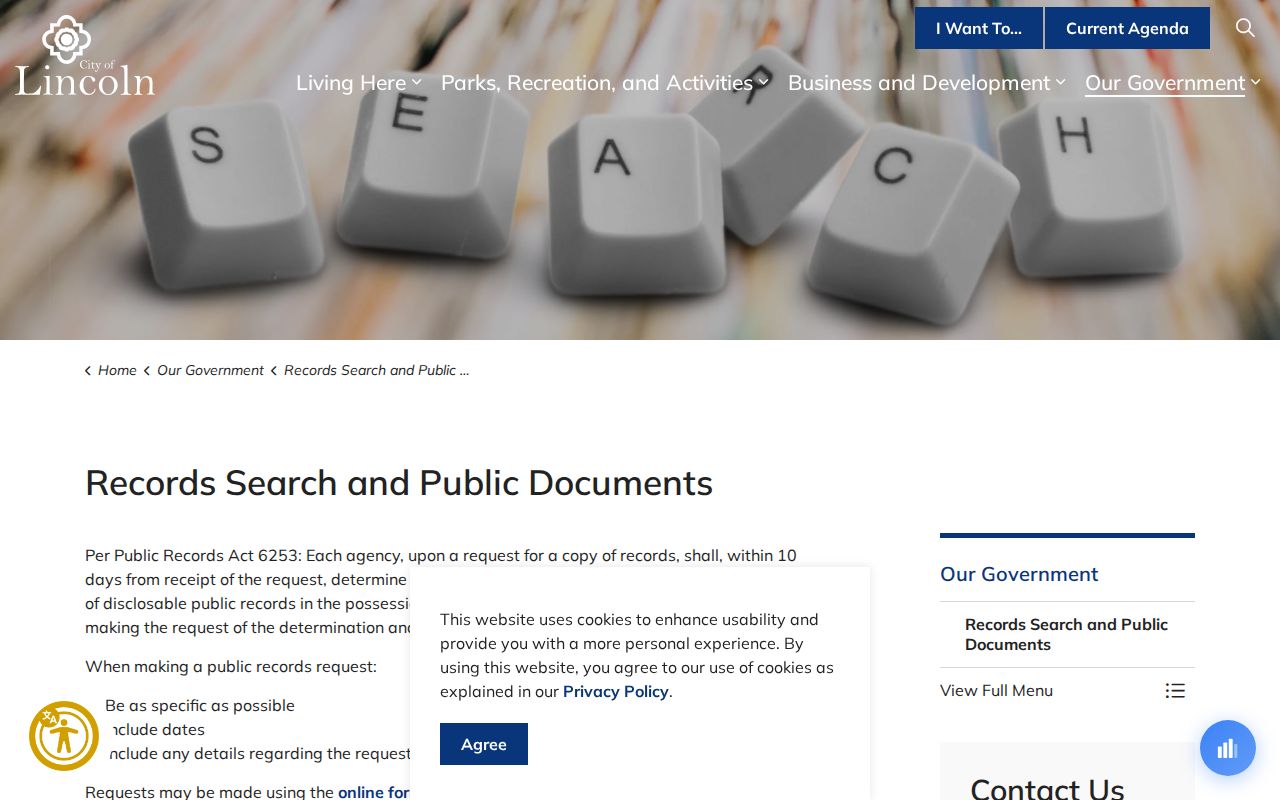
Lincoln's public-records page identifies the request channels and the City's records route.
Note: The CPRA request route is for existing, nonexempt City records; it is not a shortcut around the Recorder's copy process for an identified deed.
Historical Lincoln Resident Directories
The paper trail behind a historical Lincoln residents directory is thin but full of surprises. FamilySearch catalogs a Placer County directory from 1861, digitized from an original held by the Lincoln Area Archives Museum. Its catalog number is DGS 104933440. It proves no complete Polk run, no local reverse directory, and no promise about which fields appear on any given page. Those gaps should stay visible.
County-level tools fill the decades. The Placer County Genealogical Society indexes marriage-license books A through G from 1851 to 1905. Its 1890 Great Register holds 4,046 names. A Placer Herald name index carries 12,206 records from 1852 to 1887, and an archives index of biographies, oral histories, and newspapers adds 23,727 entries. Test a past household against deeds, census schedules, newspapers, and probate rather than one directory volume. A single book never has to carry it all.
The Lincoln city directories page gathers the full collection trail. Modern street and parcel evidence belongs in the Lincoln by-street records workflow. The two angles meet when a historic address must be matched to a current parcel.
Where Lincoln History Is Shelved
Where the shelves sit is itself a search clue. Twelve Bridges Library is a city-run joint-use facility at 485 Twelve Bridges Drive, and its published number is 916-434-2410. Ancestry Library Edition works in building only. HeritageQuest runs remotely with a library card. The nearest Placer County Library branch sits in Rocklin, a separate system from the City of Lincoln library.
The Placer County Archives keeps county records from the 1851 organization era alongside maps, photographs, oral histories, newspapers, and private manuscripts. Published listings disagree between 11523 and 11526 C Avenue in Auburn, and public research blocks vary too. Call 530-889-7789 before any visit. The insider check is worth the minute. A catalog lead is not a confirmed reading-room appointment.
Lincoln's 1909 Carnegie library drew funding from Carnegie, Gladding McBean, and residents before closing in 2011. Twelve Bridges opened in 2007. Those civic milestones open doors to school, pottery, railroad, club, church, and newspaper material. A named directory or yearbook run still needs catalog confirmation.
Protected Records Need a Different Route
Some records are closed by law rather than by oversight. California keeps its birth, death, and marriage indexes confidential under Health and Safety Code section 102230. A certified copy requires statutory eligibility, and even an informational copy carries an identity-use warning. The documented CDPH vital-record fee schedule spells out the current costs of ordering. Safe at Home offers qualifying at-risk residents a substitute mailing address and confidential voter registration. The federal Driver's Privacy Protection Act likewise keeps DMV personal information private. It stays out of any ordinary resident search.
The Delete Act adds another wrinkle. It created DROP, a single-request mechanism for registered data brokers. Its rules take effect January 1, 2026. That path targets broker-held data, not the public records kept by Placer County or Lincoln. Anyone who spots an error in an assessment, court, voter, license, or vital record can ask the holding office for a correction. A private directory cannot change a source record at its origin.
Lawful personal use. Lincoln records can support family history, reconnecting, estate research, civic understanding, and personal safety awareness. Do not use a name or address trail to stalk, harass, intimidate, or harm anyone. Verify important information with the custodian before relying on it.
Commercial tools blur lines. They may mix public and private data, charge for access, or merge two people with similar names, so treat a hit as a lead only. Official records, document numbers, and custodian confirmation carry the weight.
Free Index or Paid Copy?
Access cost and evidentiary value are different things. Lincoln research often starts free. Then it moves to a paid copy or an in-person review when the question needs proof.
| Route | Best Use | What It Does Not Prove |
|---|---|---|
| GIS map | Find a parcel and understand geography | Current occupant or legal title |
| Assessment Inquiry | Read parcel-keyed roll facts | Every household member |
| Recorder index | Find a deed reference and party role | Remote image access |
| Office copy or court file | Inspect the record behind an index | A guarantee that a name belongs to the person sought |
| Directory or archive | Test an earlier household or social link | Continuous residence between publication years |
The strongest Lincoln residents directory result is a chain of two or more independent anchors. A parcel plus deed beats a parcel alone. A case number plus filing date beats a same-name court hit. An obituary plus a dated address beats an undated profile. Log the source, the date accessed, the field used, and whether each answer came from an index or an image. The habit pays for itself.
Lincoln's Record-Keeping Timeline
Lincoln's records read better with the civic timeline beside the source list. Placer County dates to 1851. Lincoln began as a railroad town in 1859 and incorporated in 1890, so an early household may appear in county records long before city minutes, licenses, or permits mention it. Context shapes the search.
- 1851: Placer County's county-era land, marriage, assessment, court, and probate series begin to organize.
- 1859: Lincoln's railroad-town period gives older searches railroad, pottery, clay, and Gladding McBean terms to test.
- 1890: The Great Register supplies a nominal population substitute after the lost federal 1890 schedules.
- 1909: Lincoln's Carnegie library becomes a civic and local-history reference point.
- 2007 and 2011: Twelve Bridges opens, while the Carnegie library later closes, changing where local research is handled.
- 2024 to 2026: Recorder fraud notices, the DROP privacy system, and Lincoln licensing changes add current access context.
A gap does not mean a courthouse disaster or a lost population. No courthouse fire is on record, and no street-renumbering history survives for Lincoln. Exact Sanborn sheet years stay open. Leave them open rather than borrowing regional assumptions.
One Lincoln Search Checklist
A clean evidence log keeps a promising clue from hardening into a false identity. Preserve the original query, including unit numbers, directionals, alternate spellings, suffixes, and date range. Standardize a mailing address through USPS if needed. A ZIP code never proves a city limit.
- Record the GIS parcel, APN context, subdivision, and jurisdiction.
- Note the assessment cycle, situs, owner mailing distinction, values, exemptions, and transfer reference.
- Save Recorder party, document type, recording date, number, and legal-description clues.
- Use court, business, license, directory, or obituary records only after adding a second identifier.
- Write down the custodian, access date, fee, restriction, and correction route for every result.
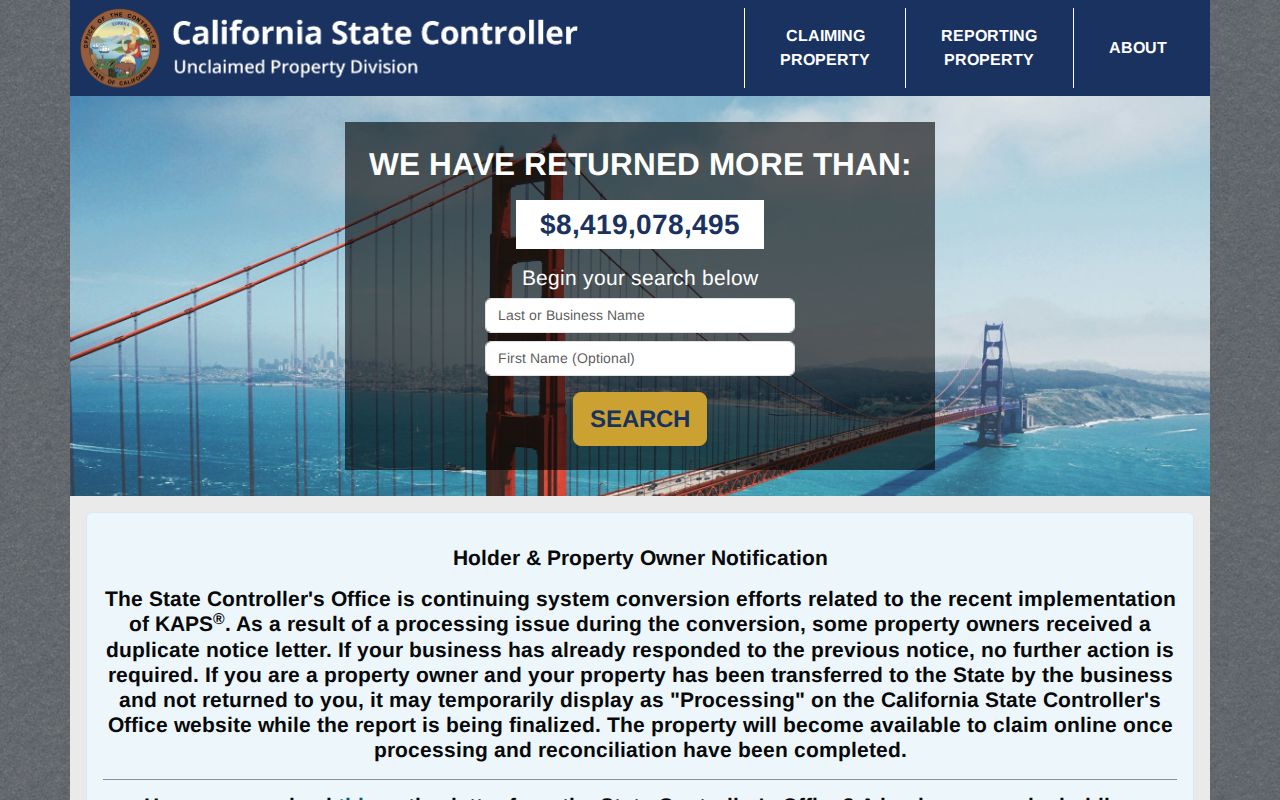
The State Controller's unclaimed-property search is free. A claim needs identity proof, and the result can suggest an earlier city or mailing connection without establishing current residence.
The State Controller's unclaimed-property search provides a free name-based lead.