
Where Lincoln's Previous Residents Leave Records
Lincoln house history is strongest when each source has a defined role. The Recorder can establish transfers and named parties. The 1861 Placer directory, genealogical indexes, and census schedules can supply historical people clues. Permits date changes to the structure, while probate and obituaries can explain why a name disappears. The first online year of the Placer Recorder index is not published, so older work may require a counter, deed book, or archival referral.
| Source | Years It Covers | Where Held | What It Shows |
|---|---|---|---|
| Recorder party index | Current; first online year unpublished | Placer Clerk-Recorder and Kofile index | Grantor, grantee, document type, number, date, reference |
| Deed scans and books | County-era series; exact start to confirm | Rocklin or Auburn Recorder counter | Conveyance, legal description, signatures, recorded image |
| Placer County directory | 1861 | Lincoln Area Archives Museum; FamilySearch image group | Cataloged directory image set; inspect the entry before drawing conclusions |
| Marriage-license books A-G | 1851-1905 | Placer records, FamilySearch films, PCGS indexes | Bride and groom names for relationship and date clues |
| 1890 Great Register | 1890 | Placer County Genealogical Society | 4,046 names with age, nativity, residence, naturalization, and registration detail |
| Placer Herald index | 1852-1887 | Placer County Genealogical Society | 12,206 name records and notice references |
| Archives name index | Varied; 23,727 entries updated April 2021 | Placer County Archives and PCGS index | Biography, oral-history, newspaper, and archival name references |
| Bill-of-sale index | 1866-1945 | County and PCGS indexes | 1,666 seller, buyer, property, value, and filing clues |
| Federal census | 1790-1950 public schedules | NARA, FamilySearch, and library databases | Household, relationship, age, occupation, and address detail where present |
| Lincoln permits | Current; historic start unpublished | Lincoln Building and Accela | Project, applicant, contractor, status, and dated work history |
Start with the current parcel when the question is about a house. Start with the named person when a directory or obituary supplies the first clue. Either route should end with two independent anchors, such as an APN plus a deed or a case number plus a known date, before names are merged.
Lincoln Parcel Records for House History
Address history begins in the present. Search the address in the Placer parcel, zoning, and land-use map, select the matching polygon, and preserve the APN, subdivision, map context, and jurisdiction. Then use Assessment Inquiry with the 12-digit Fee Parcel Number or Assessment Number. The assessment result can connect the parcel to an owner, owner mailing address, situs address, last transfer date, deed number, values, exemptions, and map fields.
The situs address is the property location. The owner mailing address is where assessment correspondence goes and may be somewhere else. That distinction prevents a mailing destination from being mistaken for the house being studied. Assessment data are reported as of January 1 and are assessment aids, not proof of legal title or residence. Use the Recorder for the recorded instrument and its legal description.
For a selected street, map book, tax area, or APN group, PCA503 is the documented Assessor data-request route. A spreadsheet of 12-digit APNs without dashes can support a defined selection. The published delivery choices include email, BOX link, or FTP, with CSV and GIS formats, after prepayment and an expected two-week period. Keep the request scope and access date in the evidence log.
Insider tip. Preserve the parcel before chasing names. A stable APN and legal description can survive a change in street formatting, ownership, or neighborhood branding.
Trace Lincoln Deed Records Backward
The Placer Recorder's grantor and grantee index is the backbone of a title trail. A grantee receives an interest. A grantor transfers it. To move backward, find the current owner's acquisition deed, read the transferor, then search that transferor as an earlier grantee. The process is name-based because the index is not a street-resident list. The APN and legal description keep the name search tied to the right parcel.
- Record the current assessment owner, APN, situs, mailing distinction, and legal-description clues.
- Search the owner in the Recorder index as grantee, narrowing by recording date, document type, party spelling, and document number when possible.
- Compare the deed reference and legal description with the parcel or subdivision map. A matching surname alone is not enough.
- Read the seller as grantor, then search that party as grantee for the earlier acquisition. Repeat one transfer at a time.
- When the online trail ends, ask about deed books, microfilm, or the daily counter index. The county has not published the online index's first year.
- Grantor
- The party named as transferring an interest in the recorded instrument.
- Grantee
- The party receiving the interest. In a backward search, today's seller becomes the next person to test as grantee.
- Chain of title
- A linked sequence of recorded transfers for the same land, checked against dates and legal descriptions.
- Legal description
- The recorded land description that can connect a parcel through a changed APN or street label.
APNs can change after splits and mergers. The earlier parcel may be found through a subdivision, lot, block, predecessor parcel, or legal description rather than the modern street address. A deed chain identifies title evidence, not every person who lived in the building.
Lincoln Deed Records: Index Versus Image
The Placer County Clerk-Recorder service gateway can lead to a party, document type, document number, recording date, and reference. The official Recorder page also describes book and page fields for older references. It does not promise a published start year, result cap, complete document-type list, or remote image display. The index result is a lead to the instrument, not the instrument itself.
The public counter in Rocklin at 3715 Atherton Road and the Auburn satellite at 2954 Richardson Drive provide the office channel for the daily grantor and grantee index and scanned originals. Recording and copy counters are open Monday through Friday, 8:00 a.m. to 4:00 p.m.; recording is 530-886-5600 and the Clerk is 530-886-5610. A mail request needs the document type, named parties, recording reference, daytime phone, return address, payment, and preferably a self-addressed stamped legal-size envelope.
The Recorder publishes noncertified copy pricing of $2 for the first page and $1 for each additional page. Its combined web description lists $4 for the first certified page and $1 for each additional page, while the fee schedule describes a $2 first-page charge plus a $2 certification charge. Fax or email delivery is listed at $4.25. Use the official copy order form and confirm the amount before mailing.
A 2024 Real Property Fraud Notification gives another timing clue. When a deed-like instrument may affect title, the Recorder automatically mails the assessed owner a notice with the first page. The notice is not a paid subscription. It can arrive before the Assessor's ownership update, which may lag by several weeks.
The official Kofile public index appears below as the deed-search step of a Lincoln house history.
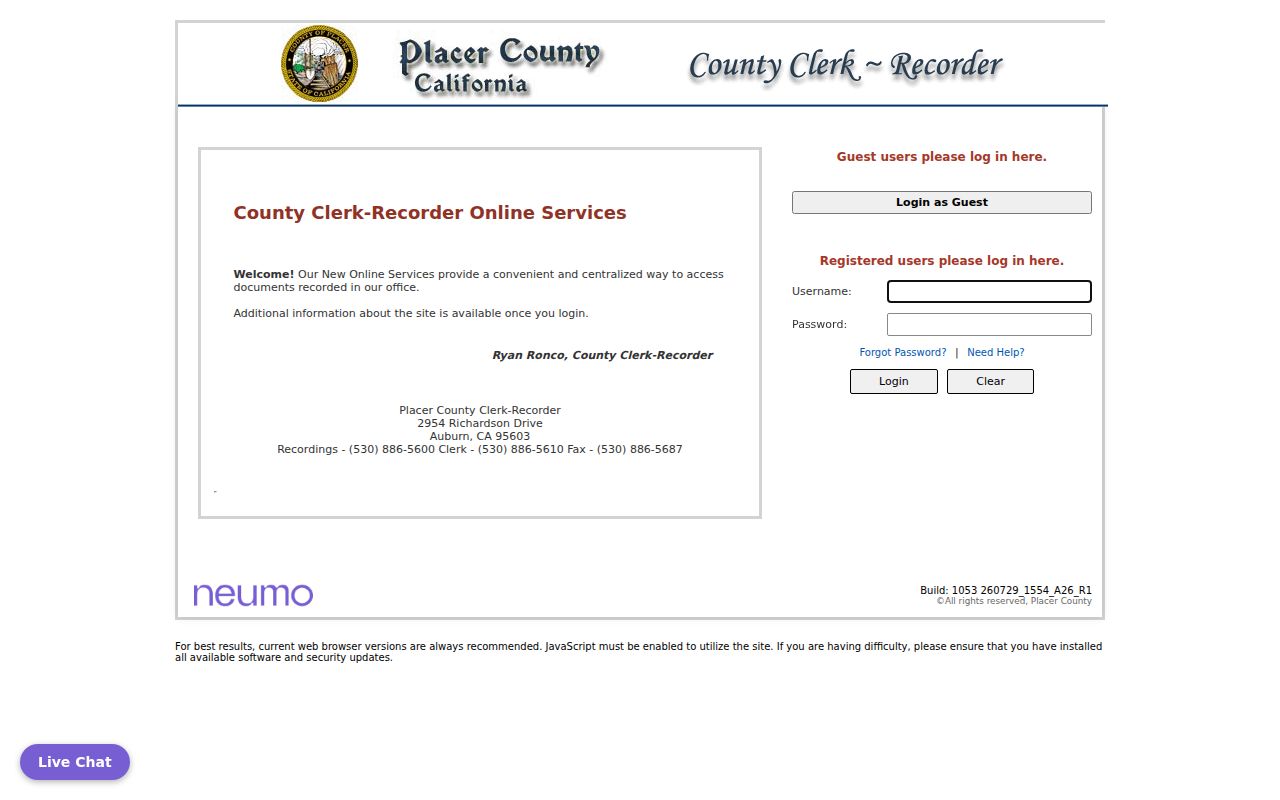
The image shows the separate public-index channel. A researcher still needs the counter, mail order, or paid delivery route when the recorded image or a certified copy is required.
Lincoln Parcel Records and Legal Descriptions
A modern APN is a strong parcel key, but it is not guaranteed to be the same through every decade. Parcel splits, mergers, subdivision recording, and assessment changes can create a break in an address-only search. Compare the current APN with the Recorder reference, subdivision index, map book, lot or block, and the exact legal description. Assessor maps help with taxation; recorded maps and deeds answer the legal-lot question.
Lincoln's planning geography can add a second bridge. The City's Neighborhood Subdivisions Map identifies named developments, while Placer's recorded subdivision index supplies map book, page, lot range, and recording references. Keep the marketing name, city planning label, and recorded legal name in separate fields. They may point to the same area without being interchangeable.
Research did not verify exact Lincoln Sanborn sheet years, a historic street-renumbering date, or a city E911 addressing rule. Those gaps should remain visible in a house-history log. Preserve old wording and test the parcel, map, and deed instead of filling a missing date with a regional assumption.
Timing clue. A Recorder fraud notice can precede an Assessor owner-roll update by weeks. A short disagreement between two official systems may reflect timing, not a new transfer.
Past Lincoln Households in Directories and Census
Deeds name parties to a transfer. They do not tell the whole household story. Printed directories and census schedules may place a person at an address for a publication or enumeration year, while newspapers and marriage indexes add relationship clues. The collections themselves are described on the Lincoln city directory collections page; the backward trail uses only the entries that match the address, era, and independent evidence.
The verified 1861 catalog record is a county directory held originally by the Lincoln Area Archives Museum, with images in FamilySearch group DGS 104933440. The research session did not expose a readable Lincoln entry or abbreviation key. An entry should not be credited with a spouse, occupation, owner mark, or reverse-address field until the image has been inspected.
For an address, write down the exact printed street wording, house number, surname spelling, and publication year. Then compare the entry with a deed, the 1890 Great Register, a marriage index, a newspaper notice, or a census schedule. The goal is a dated association, not a claim that every name in a directory was a current owner.
Lincoln's 1861 Directory and Name Indexes
The 1861 Placer County directory is unusually useful because its catalog provenance points to Lincoln Area Archives Museum rather than an invented long run of local titles. The FamilySearch catalog confirms the place, year, holding institution, digitization year, and image group. Access may require sign-in or an affiliate location. Treat the catalog as a verified collection lead and the image as the evidence for any line-level claim.
California county and city records held through the State Archives collections gateway can help bridge a directory gap. The state collection channel shown below is also useful when a county-era series is known but a convenient web index is not. Placer County Archives holds county records, maps, photographs, newspapers, oral histories, and manuscripts; published listings differ on whether the Auburn address is 11523 or 11526 C Avenue and on the public schedule, so call 530-889-7789 before visiting.
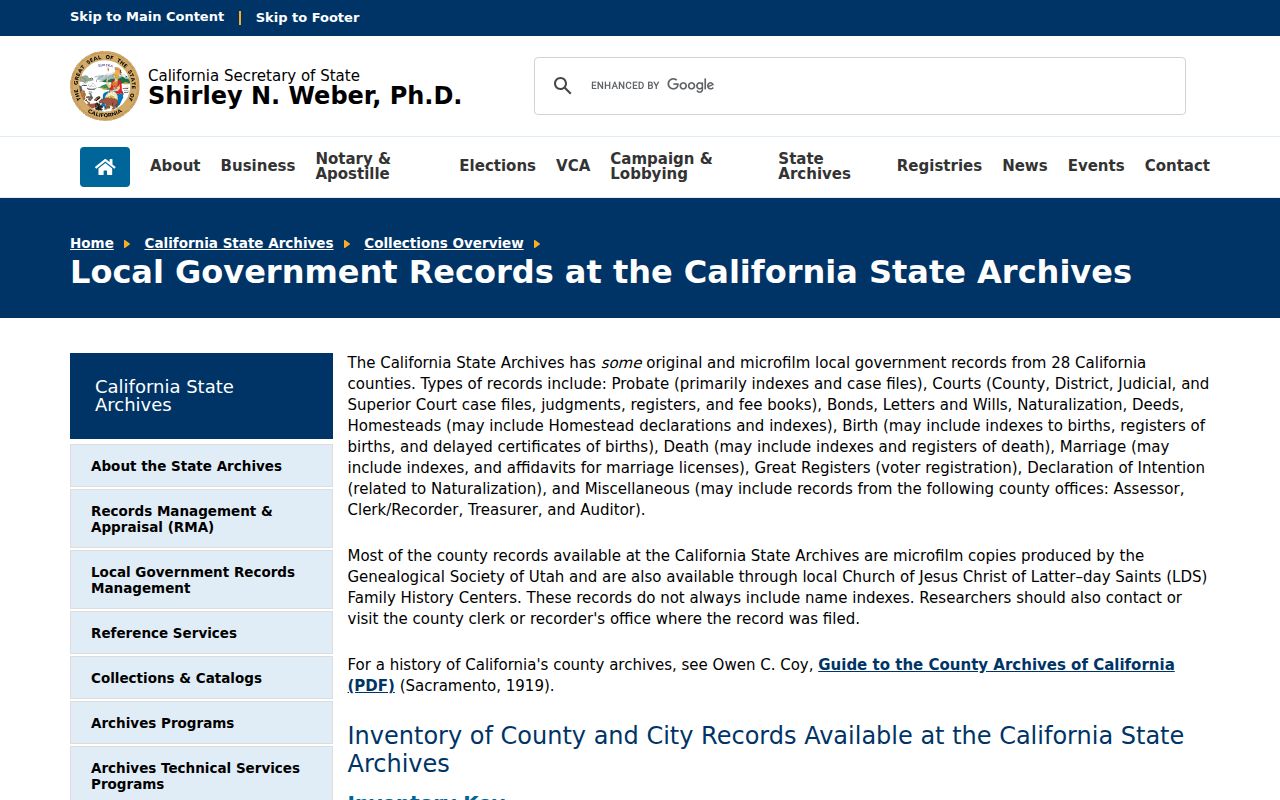
The archive view reinforces a key rule for previous residents: a catalog, finding aid, and digitized image are three different levels of access. Record which level supplied each name.
- The Placer marriage-license books A-G cover 1851-1905 and are indexed by bride and groom; FamilySearch films 1295539-1295541 are a related route.
- The 1890 Great Register contains 4,046 names with age, nativity, residence, naturalization date or place, and registration date.
- The Placer Herald name index contains 12,206 records from 1852-1887; the PCGS notice-copy service charges $5 for the first notice and $3 for each additional notice in the same order.
- The Archives biography, oral-history, and newspaper name index contains 23,727 entries as updated in April 2021.
- The bill-of-sale index contains 1,666 records across volume spans from 1866 through 1945, with seller, buyer, property, value, and filing clues.
These sources are best treated as name and date anchors. A newspaper notice or bill of sale can support an identity link, but it does not by itself prove that a person occupied the Lincoln address under review.
Lincoln Census Records for Past Households
The federal census adds household structure that a deed index cannot. Person-level schedules through 1950 are public under the 72-year rule, and the Census Bureau's decennial-record context helps distinguish disclosure rules from a current resident roll. The 1950 schedule is the newest public decennial set at the research date. A census address may use a route, township, enumeration district, or older place label, so a modern Lincoln street number should not be forced onto it without a map or household match.
The census image below links to the official NARA 1950 research gateway. It is a source for household and relationship evidence, not a current resident roll.
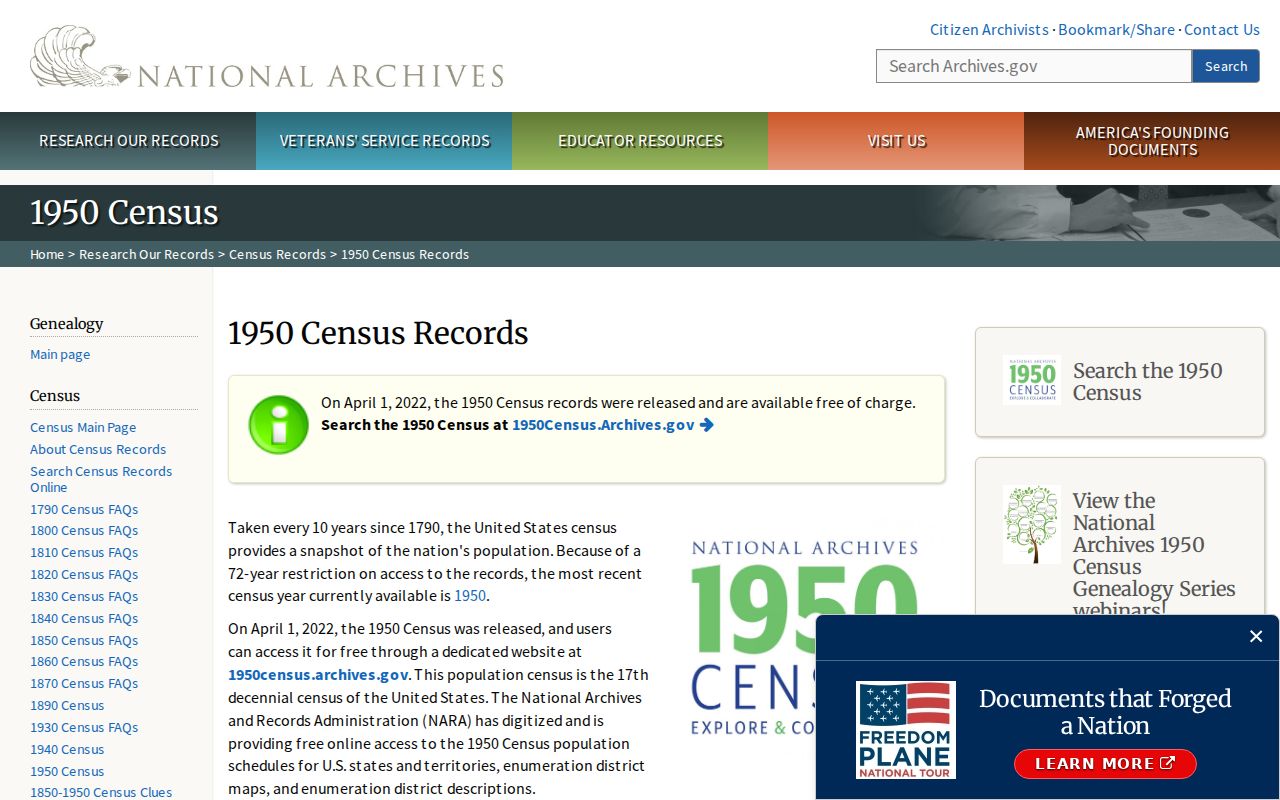
Use the census with a dated directory entry or deed rather than alone. The 1960 schedule is not yet public in the research record and is scheduled for release in 2032, so the public federal household trail has a real boundary.
- Write the directory's exact address, spelling, and publication year, then identify the closest census year and enumeration district.
- Compare names, ages, relationships, occupations, and nearby households. Use a street or map clue when the printed address changed.
- Log the census page, directory title, access date, and any mismatch. A difference may reflect a move, a spelling variant, or a different enumeration boundary.
- Test the household against the deed chain, marriage index, obituary, or probate record before treating it as the same Lincoln household.
Lincoln Records: Permits, Probate, Obituaries
Permits can date a physical change without proving residence. The Lincoln Accela channel may show a project description, applicant, contractor, status, contact, and date. Older city records can be requested through the City's public-records process. For an unincorporated parcel with a Lincoln mailing address, Placer CDRA is the better permit custodian. Always label the role shown in the record.
Probate belongs to Placer Superior Court, not the County Clerk-Recorder. The Placer Superior Court site covers public case discovery by category, filing date, case number, or party/company name, but sealed, juvenile, adoption, mental-health, search-warrant, and other restricted material is excluded remotely. A probate petition or notice can explain an owner's disappearance or an heir connection, subject to access rules. The Gibson Courthouse public terminal and file room are in-person alternatives; clerk name searches cost $15 when they take more than ten minutes, and the court copy-request guidance covers written copies using form PL-CW001, a mailed request, SASE, and check. Phone, email, and fax copy orders are not offered.
Local newspaper notices, obituaries, cemetery references, and family-history records can mark the end of an address association. Corroborate a same-name obituary with age, spouse, town, parcel, or a known relative. An obituary is a clue and a community record, not a substitute for a certified vital record or court file.
Evidence log. For each prior resident, record the source title, date or coverage year, exact address wording, APN or case number, access date, and whether the source was an index, image, or full file.
Lincoln Neighborhood Records Across Eras
Lincoln's older railroad, downtown, and pottery core favors deeds, directories, newspapers, maps, and occupational terms such as railroad, potter, kiln, clay worker, and Gladding McBean. A past resident may be easier to find through a county record or local notice than through a modern parcel screen. Lincoln began as a railroad town in 1859 and incorporated in 1890, so pre-incorporation people appear mainly in county land, court, tax, census, railroad, pottery, and community records.
Twelve Bridges, Lincoln Crossing, Sun City Lincoln Hills, newer Villages, and other planned areas leave a different record mix. Tract maps, permits, assessment data, subdivision records, and association governance are more useful starting points. A development name is a search term, not proof of one universal organization or a person's presence. Use the exact recorded subdivision and APN before joining a modern name to a historical address.
The 1909 Carnegie library, the Twelve Bridges joint-use library opened in 2007, and the high school opened in 2021 are useful chronology markers for civic, school, and community ephemera. They can point to yearbooks, photographs, and local-history referrals, but exact holdings must be confirmed with the custodian.
Lawful Limits on Lincoln Previous Residents Research
Previous residents research is a house-history and family-history method, not a promise that every person connected to an address can be named. California's comprehensive vital-record indexes are confidential. My Voter Status is authenticated, voter files require a qualified purpose, and Safe at Home can place a substitute address into official records. A missing result may reflect a legal protection rather than a gap in a person's life.
Use the California Public Records Act for existing, nonexempt city or county records when a documented permit, correspondence file, or other record is not already online. The Act does not require a new directory, and it cannot override a confidentiality rule. Stop at a protected boundary, preserve the reason, and use the custodian's correction or authorized-request route instead of filling the gap with an unverified compilation.
Lawful house history. Lincoln previous residents research is appropriate for genealogy, property history, estate and heir work, and personal civic inquiry. Do not use names, addresses, or records to stalk, harass, threaten, or harm a living person. California Penal Code sections 646.9 and 530.5 set serious limits on misuse.